
What Happens When We Wait?
Author: L. Pears
The automobile arrived before the roads, rules and infrastructure needed to support it. Dallas should not repeat that history with public safety.
In 1886, Carl Benz patented what is widely recognized as the first practical automobile powered by an internal-combustion engine.
It was an extraordinary invention introduced into a world that was not ready for it.
The automobile did not arrive with paved highways, traffic signals or standardized road signs. It did not come with driver examinations, license plates, traffic laws or highway patrol officers. The machine appeared first. Nearly everything required to operate it safely came later.
Much later.
The roads of the period had been built primarily for horses, wagons and local travel. Rain turned many of them into mud. Vehicles became stuck, routes were difficult to follow and travel between communities could be unpredictable.
The automobile exposed a problem. The existing infrastructure could no longer support the way people were beginning to live.
Government responded, but it responded one problem at a time.
One Solution Created the Need for Another
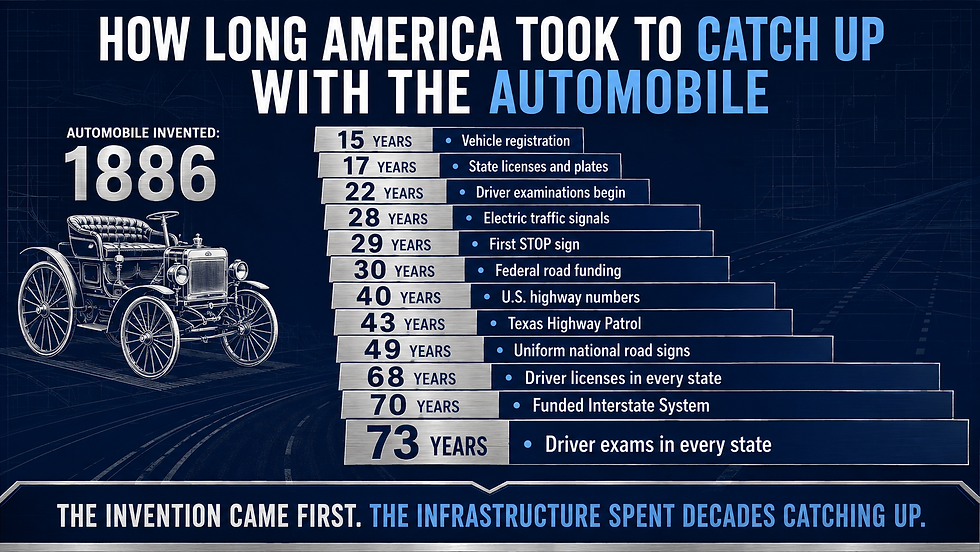
New York began registering automobiles in 1901, fifteen years after the automobile was invented. Massachusetts began issuing state licenses and registration plates in 1903.
The country had begun identifying cars and drivers, but that did not mean drivers had demonstrated that they knew how to operate them. Rhode Island did not introduce a driver examination until 1908.
By then, the automobile had existed for twenty-two years.
Electric traffic signals appeared in 1914. The first STOP sign followed in 1915. The first significant federal road-funding program arrived in 1916, thirty years after Benz received his patent.
The numbered United States highway system was not established until 1926.
Texas created its Highway Patrol in 1929 because expanding roads, increasing traffic and new laws required a dedicated statewide enforcement capability.
National standards for road signs, signals and pavement markings did not arrive until 1935. Before that, the meaning, shape and appearance of traffic-control devices could vary between jurisdictions.
Every state finally required drivers to be licensed in 1954. Every state required an examination before licensing by 1959.
That was seventy-three years after the automobile was invented.
The modern Interstate Highway System was launched and funded in 1956. The transportation network most Americans now associate with automobile travel did not arrive until seven decades after the machine it was built to support.
This Is What Delay Looks Like
It is easy to look at that history and wonder how it possibly took so long.
The answer is uncomfortable because it is familiar.
Delay rarely begins as a decision to wait seventy years. It begins with a decision to wait one more day.
One day becomes a week. A week becomes a month. A month becomes another budget cycle. Another budget cycle becomes another bond program, another study, another temporary repair and another promise that the problem will be addressed later.
Then ten years have passed.
Eventually, an entire generation has learned to accept a temporary condition as normal.
That is how a police academy intended to be temporary in 1990 can still be used more than thirty-five years later. It is how a downtown fire station rebuilt in 1953 can remain in service after Dallas has been transformed around it. It is how evidence and property can continue accumulating inside facilities never designed for the volume, technology or forensic responsibilities of a modern police department.
Nothing dramatic has to happen on the first day of delay.
That is what makes delay dangerous
The consequences accumulate quietly. Buildings age. Equipment becomes obsolete. Repairs become more expensive. Available space disappears. Technology becomes harder to install. Operational workarounds become standard procedure.
People become exceptionally good at functioning inside systems that should have been replaced years earlier. Their professionalism can temporarily conceal the weakness of the infrastructure supporting them.
Eventually, the city begins mistaking employee adaptability for facility adequacy.
They are not the same thing.
Dallas Has Already Waited
Proposition A addresses five public-safety infrastructure needs:
-
Completion of the Law Enforcement Training Center at UNT Dallas
-
Development of a specialized Public Safety Training Complex
-
Replacement of inadequate police property, evidence-storage and crime-laboratory facilities
-
Relocation and modernization of 911 and Emergency Operations Center functions
-
Replacement of Dallas Fire-Rescue Station No. 4
These are not five unrelated construction projects bundled together for convenience. They are five components of the same public-safety system.
Police officers must be trained before they can serve effectively. Their training must include classroom education, decision-making, firearms proficiency, emergency driving and realistic tactical preparation.
Evidence must be received, documented, preserved and protected. A prosecution can depend on the integrity of a single item stored for years or even decades.
Emergency calls must be received and dispatched through reliable technology. During a major incident, the Emergency Operations Center must coordinate agencies, information, resources and decisions without being limited by an outdated physical environment.
Firefighters and paramedics need stations capable of supporting modern apparatus, equipment, staffing and emergency power requirements.
Each project serves a different function, but all five support the same outcome: a public-safety system capable of protecting a modern city.
Temporary Has a Cost
The argument against investing in infrastructure often begins with the price of taking action.
That is a legitimate question. Public money must be treated responsibly, and every major project deserves scrutiny.
But the cost of acting is only half of the equation.
Waiting also has a cost.
Maintaining an outdated facility costs money. Repairing infrastructure that has exceeded its intended usefulness costs money. Splitting operations across inadequate locations creates inefficiencies. Working around technological limitations consumes time. Delayed projects become more expensive as labor, materials and financing costs increase.
Operational risk also carries a cost
Inadequate training facilities can affect readiness and limit the realism of instruction. Poor evidence-storage conditions can create chain-of-custody, preservation and liability concerns. Aging emergency-communications infrastructure can threaten continuity when the system is needed most. An obsolete fire station can restrict capacity and complicate the placement of modern apparatus.
Doing nothing is not free.
It simply moves the cost into another column and gives it another name.
Sometimes it is called maintenance. Sometimes it is called inefficiency. Sometimes it becomes overtime, liability, delay or emergency repair.
Sometimes the cost does not become visible until something fails.
Infrastructure Must Follow the Mission
The automobile changed transportation faster than government changed the system surrounding it. The country spent decades building the roads, signs, regulations, licensing systems and enforcement capabilities required to catch up.
Dallas is facing the same kind of institutional decision today.
The city has changed. Its population has grown. Police and fire operations have become more complex. Evidence volumes have increased. Technology has transformed emergency communications. Training expectations have expanded. The threats facing a major American city have evolved.
The infrastructure supporting public safety must evolve with them.
This does not require extravagant buildings. It requires functional, secure and properly designed facilities capable of supporting the mission for which they are intended.
The question is not whether Dallas can continue operating inside outdated facilities tomorrow morning. Dedicated employees will report for duty and find ways to make the system work, just as they have for years.
The real question is how much longer Dallas should ask them to do it.
What Happens When We Wait?
Every day becomes a week.
Every week becomes a month.
Every month becomes another year of repairs, workarounds and growing risk. Before long, ten years have passed and the city is still discussing a need everyone recognized at the beginning.
America spent seventy-three years developing a complete system of driver licensing and examinations after the automobile arrived. It took seventy years to finance the modern Interstate Highway System.
We can look back and call that delay ridiculous.
The more important question is whether future generations will say the same thing about us.
Proposition A gives Dallas an opportunity to stop reacting to yesterday’s deficiencies and begin preparing for tomorrow’s responsibilities. It is an opportunity to complete projects that have been discussed, studied, delayed and promised for years.
The invention came first. The infrastructure spent decades catching up.
Dallas already knows what public safety requires. It should not take another generation to provide it.
